
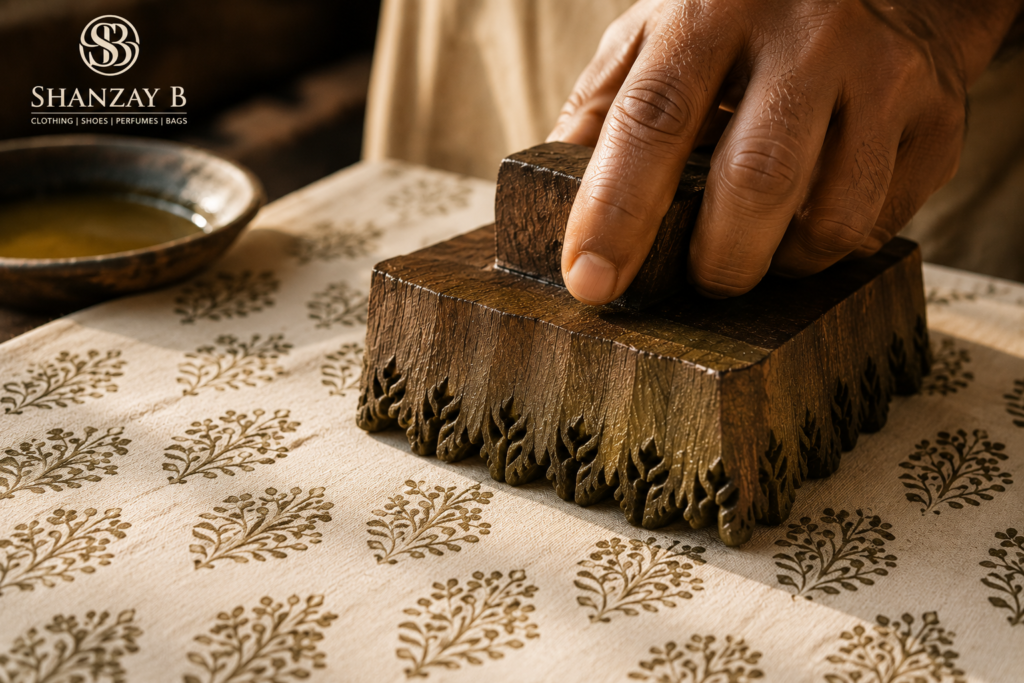
Every block-printed piece in our collection starts the same way: not with a machine, but with a carved block of wood and a steady hand. Here’s what actually goes into the technique before it ever reaches a hanger.
Carving the Block
Each pattern begins as a design carved into a block of seasoned teak or sheesham wood, often by hand, with the raised surface forming the part that will eventually touch the fabric. A single complex motif can require multiple blocks — one for outlines, separate ones for each additional color — all carved to align precisely with one another.
Preparing the Fabric
Before any printing happens, the fabric is washed and treated to help it hold dye evenly. This step matters more than it seems — untreated fabric absorbs dye unevenly, leading to patchy, inconsistent results once the printing begins.
The Printing Process
The carved block is dipped in dye and stamped onto the fabric by hand, one repeat at a time, requiring a steady, practiced rhythm to keep the pattern aligned across the full length of fabric. A skilled printer can maintain remarkably consistent spacing without any mechanical guide — something that becomes obvious when you compare it to the perfect, mechanical repetition of a machine-printed textile.
Why This Process Creates Real Variation
| What You’ll Notice | Why It Happens |
|---|---|
| Slight variation in pattern spacing | Natural result of hand stamping vs. machine precision |
| Small color depth differences between batches | Natural dyes and manual mixing vary slightly each time |
| Occasional soft edges on motifs | The texture of hand pressure, not a flaw |
These aren’t defects — they’re the actual signature of the technique. A perfectly uniform, mechanically identical print is usually a sign the piece wasn’t block printed by hand at all.
Why It’s Worth Choosing Over Machine Print
Hand block printing supports a smaller-scale, skilled craft tradition rather than industrial textile production, and the resulting fabric carries a texture and depth that flat digital printing doesn’t replicate. It’s slower, and it shows in the price point — but it’s also genuinely a different object than a machine-printed equivalent.
Frequently Asked Questions
Is hand block print more durable than machine print?
Durability depends more on dye quality and fabric care than the printing method itself, though hand block-printed pieces are often made with more attention to fabric preparation overall.
Why do hand block-printed pieces cost more than printed alternatives?
The labor is significantly more time-intensive — each repeat is stamped individually by hand, compared to a machine that can print continuously at high speed.
Can I tell if something is genuinely hand block-printed just by looking at it?
Look closely for small, natural variations in spacing or color depth between repeats — a pattern that’s mechanically perfect and identical throughout was more likely digitally or machine printed.
Explore our hand block-printed pieces in the clothing collection, or read more about our approach on the Craftsmanship page.