There’s a specific kind of relief in finding an outfit that works for a 9am meeting, survives a commute, and still feels like you — not a costume version of professional, not a compromise on culture. For a lot of women wearing Pakistani pieces to offices in New York, Toronto, Sydney or London, that outfit isn’t always obvious. Occasion wear is easy to find. Everyday festive is easy to find. Workwear, somehow, rarely gets the same attention — even though it’s the thing most of us actually get dressed for five days a week.
This guide is about closing that gap: how to build a Pakistani-rooted work wardrobe that reads as sharp and intentional in a Monday morning meeting, using pieces that already exist in most closets and a few smart additions.
Why 2026 Is a Good Year for This
Office style in Pakistan itself has been shifting toward what stylists are calling “smart minimalism” — neutral palettes, wrinkle-resistant fabrics, and tailored cuts replacing heavier, more embellished silhouettes for daily wear. Three-piece suits paired with long coats and cigarette trousers are holding steady in corporate settings, and printed scarves are increasingly standing in for heavier dupattas on busy days. The throughline is discipline: fewer, cleaner lines, and clarity over decoration.
That shift happens to translate very well into a Western office. A tailored three-piece suit in a neutral tone, a long line kurta over slim trousers, or a considered co-ord set all read as “put-together professional” to a US or UK colleague without needing any explanation. You’re not translating an outfit; the outfit already speaks the language.
The Building Blocks of a Pakistani Work Wardrobe
1. The Long Kurta + Trouser Combination
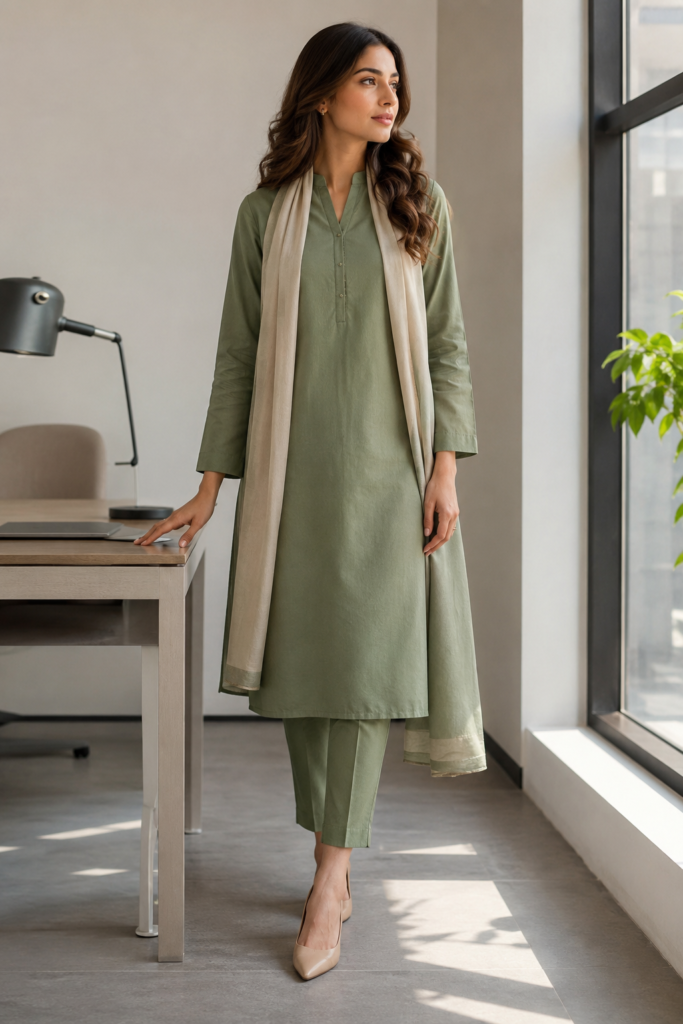
A straight-cut, ankle or knee-length kurta over cigarette trousers or slim-fit pants is the single most versatile piece you can own for work. Keep the kurta in a solid neutral — ivory, sage, dusty mauve, or bottle green — and let the fabric do the talking rather than the print. A slightly structured cotton or linen-blend kurta holds its shape through a full day better than lawn, which tends to soften and wrinkle by early afternoon.
2. The Three-Piece Suit, Reworked
A classic three-piece suit (kameez, trouser, dupatta) can absolutely work in an office — the trick is in how you style the dupatta. Skip the full-drape and instead wear it as a long scarf around the neck, or fold it narrow and drape it over one shoulder. This keeps the silhouette clean and prevents it from reading as occasion wear. Pair with minimal jewellery: small studs, one thin bangle, nothing that catches light across a conference table.
3. Co-ord Sets
Matching two-piece sets — a straight top and a wide-leg or straight trouser in the same fabric and colour — are quietly one of the smartest workwear investments you can make. They photograph as intentional, they eliminate the guesswork of “does this top go with these pants,” and a well-cut co-ord set in a solid or subtle print does the same job a Western trouser suit does, just with more texture and colour options.
4. Layering With a Long Coat or Cardigan
This is the detail that’s trending hardest in Pakistan’s own workwear scene right now: a long, structured coat or a long knit cardigan worn over a simple suit or co-ord. It adds warmth for colder climates (useful if you’re dressing for a Toronto winter or a London office), it elevates a simple base outfit instantly, and it borrows a very Western silhouette while the pieces underneath stay rooted in Pakistani tailoring.
Colour and Fabric Choices That Read as “Office,” Not “Occasion”
- Solids over prints — a solid kameez or kurta in a considered neutral will always look more “meeting-ready” than even a subtle print.
- Matte over shine — cotton, linen-blend, and matte crepe read as professional; anything with a visible sheen tends to read as evening wear, even in a modest cut.
- Muted palette — dusty mauve, sage green, powder blue, ivory, and bottle green are trending for exactly this reason: they’re versatile enough to move between desk and dinner without a full outfit change.
- Structured over flowy — a slightly stiffer fabric holds a silhouette through a full workday; very soft, drapey fabrics tend to look rumpled by 3pm.
Building a Five-Day Rotation From Six Pieces
You don’t need a separate outfit for every day of the week. A well-chosen capsule does more work than a full wardrobe of one-off pieces:
- 2 long kurtas in neutral solids
- 2 pairs of trousers (one straight, one wide-leg) in colours that pair with both kurtas
- 1 co-ord set in a versatile colour
- 1 three-piece suit, styled down with minimal jewellery for the office
- 1 long cardigan or coat that layers over everything above
Mixed and matched, that’s enough for a full week without repeating a single look — and every piece still works for dinner, travel, or a weekend brunch once you swap the styling.
What to Avoid
- Heavy embellishment. Save embroidery-heavy pieces for evenings and occasions; even light zari or gota work can read as too dressed-up for a standard workday.
- Full dupatta drapes with pins. Beautiful for events, but they restrict movement in a way that’s genuinely impractical at a desk or in meetings.
- Very sheer fabrics without proper lining. Office lighting is unflattering enough without fabric that doesn’t hold its own structure.
Dressing for Your Climate
One thing that rarely gets addressed in general styling guides: Pakistani workwear needs different fabric weights depending on where you actually live and work.
- United States & Canada — layer for indoor heating in winter and air conditioning in summer. A cotton kurta with a light cardigan works nearly year-round; swap in a wool-blend long coat for the coldest months.
- Australia — lean into breathable cotton and linen-blend fabrics for most of the year, and reserve heavier khaddar or velvet-accented pieces for the shorter winter stretch.
- Europe — a long structured coat over a simple kurta-and-trouser set handles the changeable weather in spring and autumn especially well, and doubles as your outerwear on the commute.
Packing a work wardrobe for travel between these climates is easier than it sounds if you stick to the capsule approach above — the same six pieces simply get layered differently depending on where you land.
Accessorizing Without Overdoing It
The line between “polished” and “overdressed” at work usually comes down to accessories, not the outfit itself. A few guidelines that hold up across most corporate settings:
- One statement piece, never two. A bold earring pairs with a plain bangle, not another bold earring.
- Structured bags over embellished ones. A clean tote or crossbody in leather reads as workwear; anything with heavy embroidery or mirror work reads as evening.
- Flats or low heels for anyone on their feet for meetings, presentations, or a long commute — comfort holds up better than height across an eight-hour day.
- Perfume in a lighter register for shared office spaces — save heavier oud or amber notes for evenings, and reach for something lighter and floral for the workday.
Building Toward This Wardrobe
If you’re starting from a few occasion-heavy pieces and want to build out a genuine work capsule, the honest advice is to buy the neutral, structured pieces first and let prints and embellishment come later, once the basics are solid. A well-made, solid-coloured kurta in a natural fibre will outlast three trend-driven printed pieces, both in wear and in how often you actually reach for it on a Tuesday morning.
This is the same principle behind Shanzay B’s approach more broadly — fewer, better-made pieces chosen for how they hold up over repeated wear, not just how they photograph once. If you’re building a work capsule from scratch, our complete guide to salwar kameez styles and fabrics is a useful next read, and our quiet luxury styling guide covers the same restrained, considered approach for pieces that move from desk to dinner.
FAQ
Can I wear a shalwar kameez to a Western office without it looking too casual or too formal?
Yes — the key is silhouette and fabric, not the garment itself. A straight-cut kameez in a matte, solid fabric with tailored trousers reads as professional in almost any Western office. Save the fuller shalwar and heavier prints for weekends.
What’s the most versatile single piece to invest in first?
A long, solid-coloured kurta in a structured cotton or linen blend. It works over trousers for the office, over jeans for the weekend, and layers under a coat for colder months.
How do I style a dupatta so it doesn’t feel like occasion wear?
Wear it narrow, either looped once around the neck like a scarf or draped over a single shoulder. Avoid the full pinned drape, which is beautiful for events but reads as more formal than a typical workday calls for.
Are co-ord sets appropriate for client-facing roles?
Very much so. A well-tailored co-ord set in a solid or subtle print is one of the closest Pakistani equivalents to a Western trouser suit, and works well in client meetings, presentations, and formal office settings.